ROWAN VALE
Circle Magic: The Old Geometry of Power
There’s a still moment—just before a candle flame rises, just before crushed herbs release their scent—when it feels as if the world quietly draws a circle around you. It’s an instinct we recognise without needing to name it. People across time have turned to the idea of the ring: a boundary, a place of focus, a way to mark that something meaningful is about to happen. For thousands of years, circles have shaped rituals, storytelling, and spiritual practice. They’re not only lines drawn for protection; they are invitations to step into a different rhythm.
Circle work, in one form or another, appears everywhere once you start noticing it. The shape is universal: the turning of the seasons, the paths of planets, the looping of snakes, the stone rings scattered across old landscapes. To make a circle—whether with chalk, rope, salt, candlelight, or simple intention—is to echo a shape that nature already knows by heart.
This isn’t a modern idea. It’s older than writing, older than folktales, older than the languages we speak. A circle doesn’t just create space—it draws you into it.
---
A Shape Older Than Memory
Long before rituals were written down, circles marked sacred ground. Think of the great stone rings that rise from the British countryside—structures aligned with sunlight at solstice, their shadows moving in perfect arcs across the grass. These places weren’t only meeting points; they were built to create a sense of crossing from one state into another. Step inside, and you were held in a space set apart from the everyday world.
Centuries later, ceremonial traditions continued that idea, using circles to define a safe working space. Folk traditions, however, often used them as places of welcome, where ancestors or guiding spirits might be invited, not kept at bay.
Whatever the approach, the heart of the practice stays the same: to draw a circle is to say, This is where the everyday ends, and something purposeful begins.
---
The Circle as Compass
Many modern earth-based traditions call the circle a kind of compass. It’s less a map and more a way of finding your bearings. Calling on the four directions—North, East, South, West—connects you with long-held stories and natural qualities:
East carries the clarity of dawn and the feel of new beginnings.
South holds the warmth of midday, creativity, and change.
West moves with the flow of water, emotion, and memory.
North brings stillness, resilience, and the grounding presence of stone and soil.
When you draw a circle, you’re not only shaping the space around you—you’re placing yourself within a wider landscape. Each direction becomes a point of connection.
This is why circle work is as much an inward act as an outward one. It’s a way of standing with intention in the world, both physically and emotionally.
---
Creating the Liminal Space
A ritual circle doesn’t rely on ornate tools. A fingertip tracing a line in soil, a quiet intention spoken before a candle, or even a slow walk around a room with a lantern can create the boundary. What matters most is the shift in awareness.
The moment you mark the circle, you create a pause—a small shift in atmosphere that signals you’ve crossed into focused space. This boundary becomes a doorway to deeper reflection or creative work.
These in-between spaces are powerful because they help quiet everyday noise. They make space for instinct, imagination, and clarity. In this way, working with a circle is less about formality and more about building a setting where your inner world can be heard.
---
Circles in Nature
Nature uses circles constantly. Old stories speak of fairy rings growing in the grass, marking places where the everyday world feels thinner. Weather patterns spiral across the sky. Tree rings record a life year by year. Animals curl into circles to rest or stay warm.
Even on tiny scales, circular patterns repeat: the coils of shells, the curling of vines, the slow turn of the seasonal wheel. These natural forms remind us that the circle is not a human invention; it’s a shape the world uses again and again.
This is why outdoor rituals can feel especially vivid. When you make a circle under open sky or among trees, the land itself mirrors the shape you’ve chosen.
---
Circle Work in Contemporary Practice
Today, people blend old ideas with modern life, shaping circle practice in ways that suit their needs. Some use traditional tools—candles at the four directions, a knife or wand to mark the boundary. Others work with stones, leaves, or shells. Many rely on visualisation alone, imagining a sphere of light forming around them.
Groups often create circles together for seasonal celebrations, shared rituals, or collective intention-setting. The circle becomes a gathering space—a temporary community with a shared purpose.
For individuals, even a short moment inside a simple circle can shift mood and attention. A salt ring for cleansing, a chalk line for grounding, or a candlelit space for meditation can create a sense of focus and calm.
The effectiveness of the practice doesn’t come from tradition or complexity. It comes from sincerity. A circle is shaped by the intention behind it.
---
The Circle as Vessel
Throughout history, vessels—bowls, cauldrons, cups—have symbolised transformation. A circle works much the same way, only on a larger scale. When you step inside it, you create a container for your thoughts, your hopes, or your creative work.
This is why circles are often used in spellwork or focused intention-setting. They help gather and hold energy rather than letting it drift away. Spoken words and silent wishes seem to settle more deeply within that held space.
Even sitting quietly inside the boundary can bring about a subtle shift. Drawing a line and stepping within it is a simple act of choice, one that says: This is my space. This is my moment.
There’s a quiet strength in claiming that.
---
A Circle for the Modern Hedge-Walker
For those navigating both ancient practices and modern routines, circle work offers a grounded way to reconnect with natural rhythms. You can create a circle before writing, meditating, reading cards, or marking seasonal changes. It builds a sense of presence.
Seasonal turning points—solstices, equinoxes, and the cross-quarter days—are especially powerful moments for this. Aligning the circle with the movement of the year can help you feel anchored within the bigger pattern of time.
Circles can also support the creative process. Many artists find that marking a boundary around their workspace—physically or symbolically—helps the mind slip more easily into imaginative flow. The desk or table becomes a temporary sanctuary.
Circle work isn’t limited to ritual. It’s a practice of focus, grounding, and connection.
---
Stepping Out Again
Closing the circle, whether done formally or with a simple breath, often brings a sense of re-entry. The world feels familiar again, but with a touch more clarity. The boundary fades and everyday life returns to its rhythm.
Yet you carry something with you: a steadier sense of self, a clearer intention, a reminder that you are part of a larger cycle.
At its heart, circle work is about remembering—remembering our place in the world, remembering the patterns that guide us, and remembering the quiet power of choosing a space to step into.
The circle holds, the circle opens, and the circle keeps turning.
And we walk its line—intentional, aware, and always returning.
All the best,
Rowan.
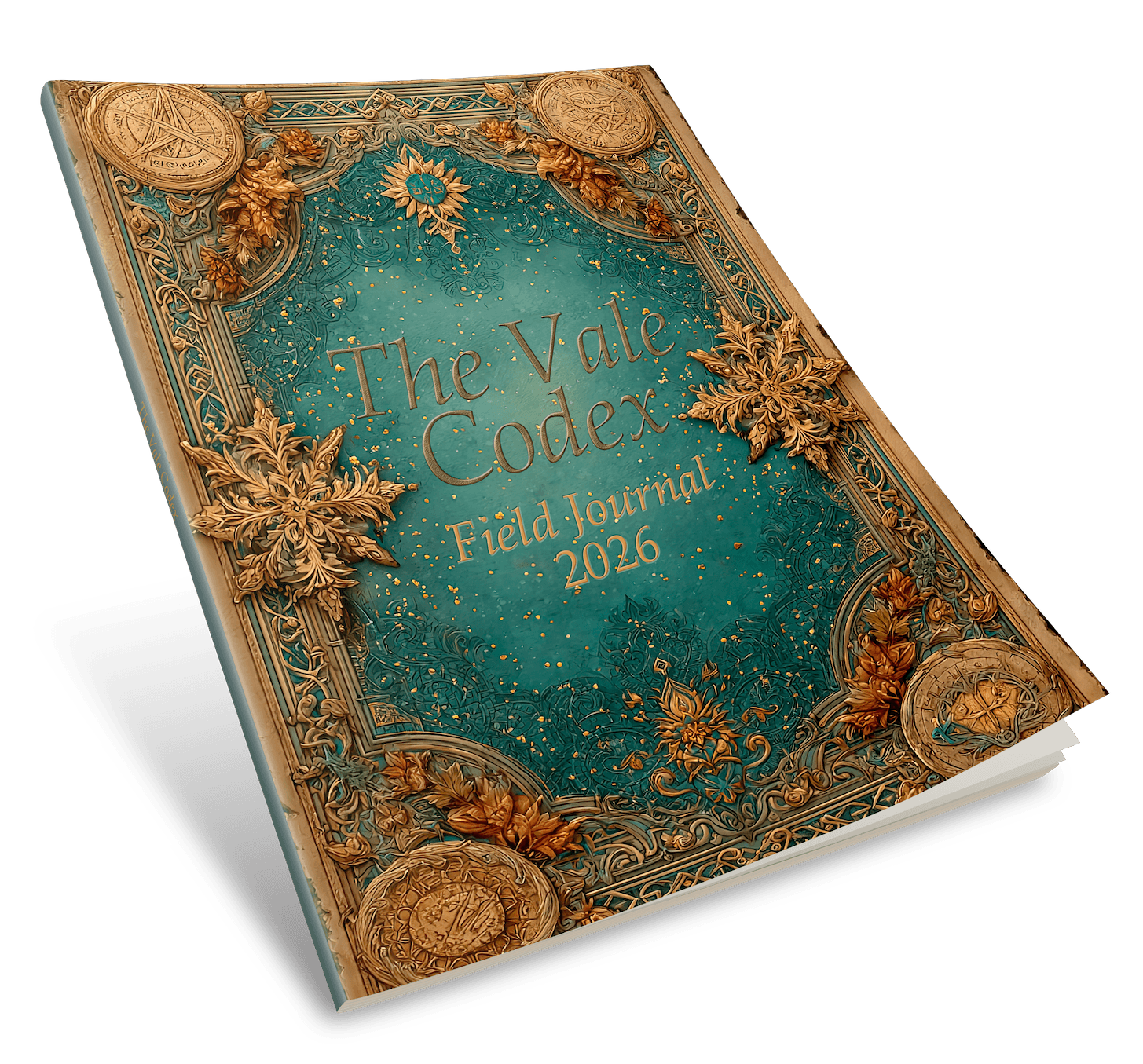
"GREAT NEWS... The 2026 Vale Codex Field Journal is available to download NOW!
The 48-page journal is a friend to carry on your own journey, expanding your mind and illuminating your path.
Tap this link to find out how to get your complimentary PDF copy right now!"
Kind regards, Rowan.