ROWAN VALE
The Mighty Dagda
From the mists of time, when memory was the only parchment and breath the only ink. Celts told their stories aloud—not written down, but passed on by druids and storytellers. These tales were only written much later, by medieval monks. Their versions often carried a Roman Christian slant. But here, now, I give you a fragment from a time before the reshaping—a tale as it was first told, when the world was younger and the voices of the storytellers rang clear, untouched by hands that would turn myth to message.
Pray, approach my virtual campfire. Gather close and let the shadows welcome you as an old friend. The tale I share now is not one for those of faint fettle. It is of a time before time, when one whose name echoes in the wind through sacred groves even today. It is a tale of the deep earth, the vast sky, and the great heart that beats between them—the heart of the Dagda, the ‘Good God’, the ‘All-Father of the Tuatha Dé Danann’, the Dagda, whose very footsteps made the earth tremble.
He was not a slender hero, not a prince of polished marble. No. The Dagda was a giant of a being, built like a hill that walked. His belly as round as the harvest moon, arms as thick as ancient oaks, and his laugh a quake that shook the very roots of the great trees. He wore a tunic so short it sparked laughter and shame in equal measure, and he carried three great treasures: a club, the Lorg Mórso so massive that it carved furrows in the earth as he dragged it behind him. One end could kill nine men with a single blow, while the other could restore them to life with the gentlest touch. "For," as he would say with a wink, "what good is the power to take if you haven't the power to give back?"
And his cauldron Coire Ansic (the ‘Cauldron of Plenty’) from which no company ever went away unsatisfied. Warriors would feast from it and find their strength renewed, poets would sup from it and discover new songs upon their lips, and the hungry would eat from it and know contentment. It never emptied, no matter how many came to partake, for the Dagda's hospitality knew no bounds.
The third was his harp, Uaithne, made of living oak and strung with golden sunbeams. The name roughly translates to “childbirth” and it symbolises harmony and concord in music. When he played it, the seasons themselves would dance to his tune. He could call forth the music of sorrow that would make the hardest hearts weep rivers, the music of joy that would set even the stones to dancing, and the music of sleep that would bring peaceful dreams to the most troubled souls.
In the days when the Fir Bolg and the Fomorians (a huge, misshapen, violent and cruel race), clawed at the edges of the world, and the Tuatha Dé Danann needed strength not of arms, but of spirit, it was the Dagda they turned to.
Now, there came a time when the Fomorians, those ancient enemies of light and life, stole away his precious harp. The Dagda's rage was terrible to behold—the skies grew dark, the earth groaned, and even the other gods stepped carefully around him. But rather than unleash destruction, he did what the Dagda always did: he walked forward to meet his challenge.
Into the hall of the Fomorians he strode, bold as brass and twice as bright, though he was but one against many. There hung his harp upon their wall, silent as sorrow. The Fomorians laughed at him, thinking him a fool to come alone.
But the Dagda simply smiled and called out in his voice like distant thunder: "Come to me, Uaithne! Come to your master's hand!"
The harp flew from the wall with such force that it struck down nine Fomorians in its flight. As it settled into his great hands, he played the three noble strains. First came the sorrow-strain, and even those dark creatures wept for all the grief they had caused. Then came the joy-strain, and they laughed until their sides ached, forgetting all thought of battle. Finally came the sleep-strain, and one by one they fell into slumber deep as winter.
And so the Dagda walked out again, stepping carefully over his sleeping foes, for he was not one to harm a helpless enemy—even such enemies as these
But I shall tell you the secret heart of the Dagda's power, the truth that even the Fomorians never understood: his strength came not from his size or his treasures, but from his great heart that held all the world within it. He was the Good God not because he was perfect—indeed, he was full of appetites and desires, mistakes and missteps—but because he chose, again and again, to be generous rather than grasping, to create rather than destroy, to feast rather than fight.
He had many lovers and many children, for his heart was too large to be contained. With the Mórrígan (whose name can be translated as ‘Great Queen’ or ‘Phantom Queen’, also known as the ‘Dark Crow Queen’) he lay, by the River Unius on Samhain eve, and their union brought protection to his people in the battles to come. Their daughter Brigid became the keeper of the sacred flame, and their son Aengus the Young inherited his father's gift for impossible love and gentle mischief.
When at last his time came to step aside—for even gods must honour the turning of the wheel—he did not fade or diminish. No, the Dagda took up residence in the Brú na Bóinne, that great mound in County Meath, by the Boyne where the sun still remembers him each winter's dawn. There he dwells still, feasting eternally, his club by his side, his cauldron ever-full, and his harp playing softly the music that keeps the world turning.
And if you doubt this tale, go you to any harvest feast and watch carefully. When the food seems to stretch further than it should, when strangers become friends over shared bread, when music makes the old feel young and the sorrowful find joy—there you will see the Dagda's great hand at work, for the Good God never truly left us. He simply learned to work in quieter ways, feeding the world one feast, one song, one kindness at a time.
This is the truth I tell you, as it was told to those before, back and back through the turnings of the world. May you feast well, laugh often, and remember always that strength without kindness is mere brutality, but strength with kindness—ah, that is the power that shapes the world.
Regards, Rowan.
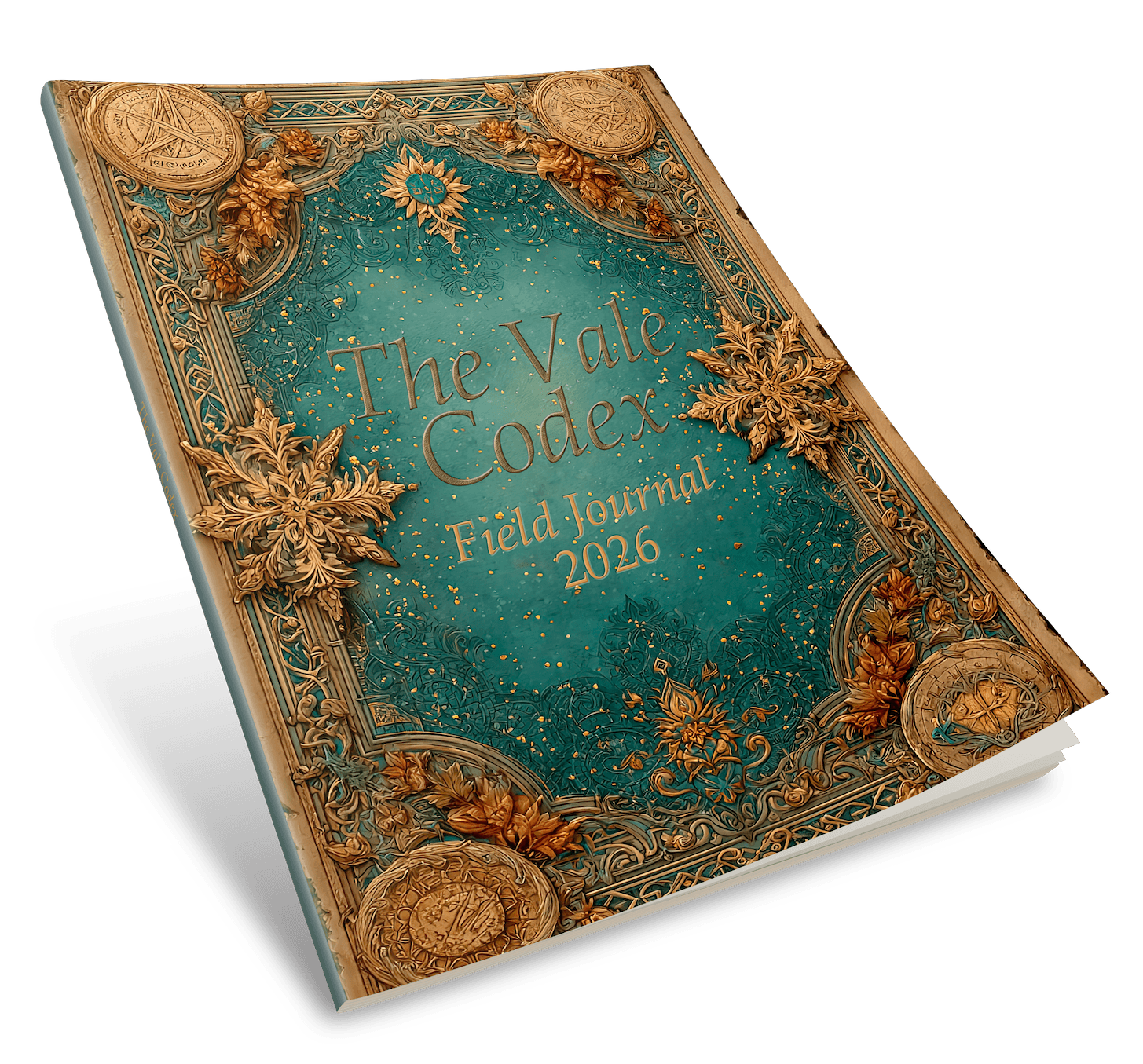
"GREAT NEWS... The 2026 Vale Codex Field Journal is available to download NOW!
The 48-page journal is a friend to carry on your own journey, expanding your mind and illuminating your path.
Tap this link to find out how to get your complimentary PDF copy right now!"
Kind regards, Rowan.