ROWAN VALE
The Longest Night
At this December threshold, the Sun stands directly above the furthest southern reach it will ever attain: the Tropic of Capricorn, positioned 23.4° below the equator's invisible band.
----
Every year, as the calendar leans toward its coldest arc, the Northern Hemisphere reaches a quiet tipping point. The sun slips to its furthest southern path, shadows draw long across frosted ground, and the night—unhurried and absolute—takes its place as ruler for a single stretch of hours.The longest night, often folded into the winter solstice, isn’t simply a celestial statistic. It’s a hinge in the year, a pause in the light, and a moment that has shaped human imagination since long before clocks, calendars, or electric bulbs softened its edge.
Despite the poetry we attach to it, the longest night begins with simple astronomy. Earth tilts. That tilt, a modest 23.4 degrees, is enough to send sunlight slipping low across the horizon in December. In the UK, daylight can shrink to barely seven or eight hours, while farther north it becomes even more fleeting. What remains is darkness—deep, lingering, and textured with the quiet of a world that has pulled inward to rest. It’s a natural contraction, the year’s slow exhale, and everything from deciduous trees to overwintering insects follows its cue.
But humans have never been content to leave this night as merely an astronomical fact. Across the world, the solstice carries a long lineage of story. For ancient farmers, the longest night marked a turning point: the moment after which the sun would start its return, bringing longer days and, eventually, the green renewal of spring. Long before written calendars, people tracked the slant of light through stone corridors, temple windows, and standing circles—engineering early monuments to catch the first sunrise after the solstice. Newgrange in Ireland, Stonehenge in England, Maeshowe in Orkney: each speaks to the significance our ancestors placed on the sun’s midwinter rebirth.
The longest night is also threaded through mythologies that sought to explain or honour the sun’s temporary weakness. In Norse lore, winter was the territory of the frost giants, a season when warmth retreated and the boundaries between worlds thinned. In parts of Central and Eastern Europe, the night before the solstice was believed to belong to spirits or wandering forces best kept at bay with candlelight, feasting, and communal warmth. In Japan, families soak in yuzu-scented baths for luck and health. In Iran, Shab-e Yalda brings gatherings, poetry, and pomegranates—a celebration of light held defiantly at the heart of darkness.
In a more modern lens, the longest night offers something slightly different: a permission slip to slow down. In a world that rarely presses pause, this one night quietly insists on it. Step outside and the usual noise softens. Streetlights hum. Houses glow like distant islands. Late trains pass half-empty across the winter landscape. The air often carries a sharper clarity, the kind that reveals constellations normally washed out by long summer evenings. Orion stands higher. The Pleiades gather like a cluster of icy pinpricks. If the weather is cold enough, sound itself seems to travel farther, unimpeded by leafless branches and quiet ground.
Nature uses the longest night as a fulcrum for its own winter strategies. Birds adjust their feeding patterns to account for shorter daylight hours. Creatures that rely on warmth, from hedgehogs to bats, have long since tucked themselves into hibernation, conserving the energy needed to reach spring. Even the winter-flowering plants that seem to contradict the season—ivy, gorse, and the occasional brave rose—are adapted for cold light, their rhythms in sync with a landscape that asks more patience than flourish. There’s a kind of discipline to winter ecology, a pared-back elegance that centres on endurance rather than abundance.
Humans mirror this, whether consciously or not. The festive rush may claim centre stage culturally, but beneath it runs the quieter, older instinct for reflection. Many people mark the solstice with small personal rituals—lighting a candle, turning off the artificial glow for an hour, taking a walk under the early dusk, or writing intentions for the year ahead. There is a kind of groundedness that comes from acknowledging the long night instead of trying to outrun it. It invites a recognition that cycles matter, that rest precedes renewal, and that darkness is not merely an absence but an essential part of the ecological and emotional year.
Communities still hold solstice events that echo ancient gatherings around fire and story. Torchlit walks wind through nature reserves. Coastal towns host lantern parades shaped like starfish, sun wheels, or mythic creatures from local lore. In some places, people gather to watch the first sunrise after the longest night, bundled in layers, breath clouding the air as the horizon begins its slow brightening. Such moments feel both modern and timeless—a shared human fascination with the point at which light and dark pivot.
What makes the longest night enduringly compelling is that it exists on multiple scales at once. On a planetary level, it’s a clean astronomical measurement. On a cultural level, it’s a marker of traditions that stretch back thousands of years. On a personal level, it’s an invitation to pause. Few other natural events gather all these threads so neatly. The solstice doesn’t demand celebration, but it quietly offers a space for recalibration. It reminds us that even in the depths of winter, change is already beginning. The earth has reached its furthest lean; from here, the pendulum swings back toward the sun.
There’s comfort in that, especially during a season when cold winds and early twilights can make the world feel contracted. While the longest night might sound like a crescendo of darkness, it actually signals the first incremental return of morning. Tomorrow, the day will be a fraction longer—so small a difference that no one will notice, but enough for migratory birds, dormant seeds, and the slow choreography of the natural world to register as the opening steps of the year’s next chapter.
In the end, the longest night is less about darkness and more about turning. It marks a threshold, the hinge between descent and ascent. Stand outside on that night—wrapped in a coat, breath rising in the cold—and you can feel the quiet weight of it. Not heavy, but profound. A reminder that even in the stillest hours of winter, the world is quietly, faithfully, moving back toward the light.
Warmly, Rowan
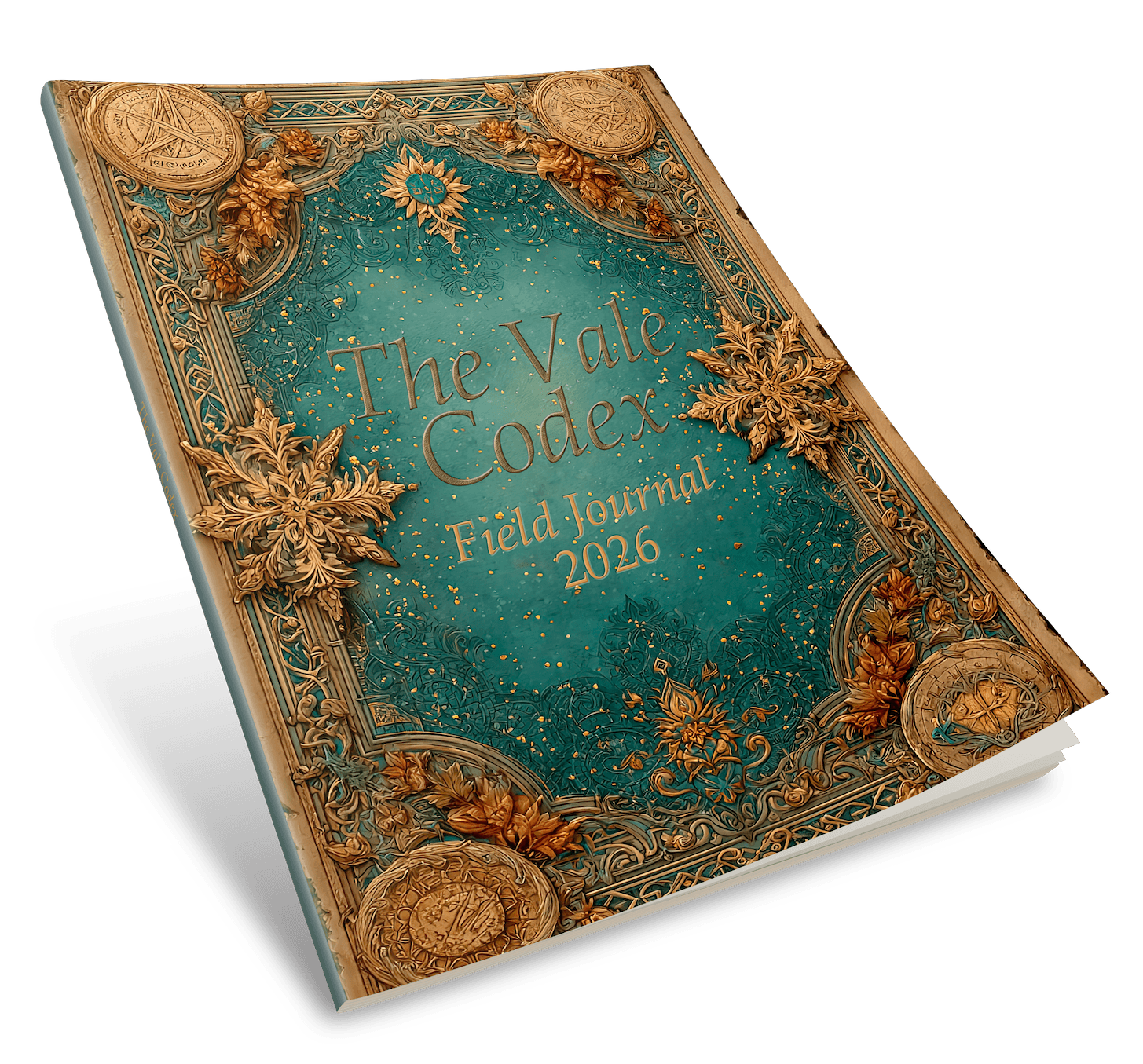
"GREAT NEWS... The 2026 Vale Codex Field Journal is available to download NOW!
The 48-page journal is a friend to carry on your own journey, expanding your mind and illuminating your path.
Tap this link to find out how to get your complimentary PDF copy right now!"
Kind regards, Rowan.