ROWAN VALE
The Great Awakening - What's Really Happening to Our World?
Why Trust, Power, Information and Consciousness Are Changing So Quickly
There are periods in history when the systems around us become so familiar that we barely notice them.
Governments govern. Markets move. News tells us what is happening. We work, shop, pay the bills and get on with life.
Then, occasionally, the curtain slips and the machinery behind becomes visible.
For many people, this feels like one of those moments.
Trust in institutions is under pressure. Artificial intelligence is changing how information is created and shared. Political and economic uncertainty has become part of everyday life. And the old information landscape has been transformed by millions of voices competing online.
People are asking questions they might once have taken for granted.
Who benefits? Who decides? Who controls the information? And are we really being shown the whole picture?
Some spiritual communities call this a collective awakening — humanity beginning to see through an old system of control.
Others see it through the lens of politics, technology or psychology.
Maybe these aren't entirely separate explanations. Perhaps they are different ways of describing the same underlying change: our relationship with authority is being renegotiated.
The popular “1%–4%–90%–5%” model is sometimes used as a way of describing this process. The percentages aren't established facts, and there's no reliable evidence that one secret group controls world events. But as a symbolic framework, the model raises an interesting question: What happens when enough people stop automatically believing the systems around them?
And what happens next?
The 1%: Concentrated Power
The phrase “the 1%” has become shorthand for those with extraordinary levels of wealth, influence and access.
In some spiritual circles, they are described as “the controllers” — a hidden group supposedly directing economies, governments, technology and public opinion.
Reality is almost certainly more complicated.
Governments, corporations, wealthy individuals, financial institutions, technology companies, media organisations and lobbying groups often have competing interests rather than operating as one giant machine.
But concentrated power is real.
Money can buy access. Ownership can influence what receives attention. Algorithms decide much of what people see online. Corporations shape markets, while governments make laws and control enormous information systems.
Power doesn't have to control everything to have an effect.
Sometimes it simply determines the boundaries within which everyone else makes their choices.

Who Controls the Story?
For much of the twentieth century, information passed through a relatively small number of channels.
Newspapers, broadcasters, publishers and governments had enormous influence over what entered the mainstream conversation.
That world has changed.
Social media, video platforms, independent journalists, creators and online communities now compete with traditional news organisations for attention. Information can travel around the world before an established institution has even responded.
This has obvious advantages.
A leaked document, eyewitness video or independent investigation can expose something that might previously have remained hidden.
But there is another side.
False information can travel just as quickly.
The collapse of one information monopoly doesn't automatically produce truth. It produces a much larger competition for attention.
That makes discernment increasingly important.
Not simply asking, “Is this mainstream or alternative?”
But asking: Is it true?
The 4%: The Visible Face of Power
The awakening model also talks about a group positioned between concentrated power and the wider population: politicians, broadcasters, executives, celebrities and other highly visible figures.
They are sometimes described as “puppets”.
Taken literally, that's far too simplistic. There is no credible basis for assuming that public figures as a whole are secretly taking orders from one hidden authority.
But there is an important idea beneath the metaphor.
Visible power isn't always the same as actual power.
A politician operates within a party, government departments, courts, lobbying networks and economic pressures.
A television presenter works within an organisation with owners, advertisers and editorial policies.
A company executive answers to boards, investors, regulators and markets.
The person we see may therefore be only the visible tip of a much larger structure.
If we want to understand power, we need to look beyond personalities and examine the systems surrounding them.
The 90%: The People Who Are Simply Exhausted
The awakening model often describes the majority as “asleep”.
I don't think that's fair.
Most people aren't spending their evenings studying corporate ownership, lobbying records, monetary policy or geopolitics.
They're working.
Raising children.
Paying rent or mortgages.
Looking after family.
Dealing with relationships, money, loneliness and uncertainty.
Then they wake up and do it all again.
Modern life also competes constantly for our attention.
Notifications appear. Videos autoplay. Advertising follows us between platforms. Algorithms learn what keeps us watching and then give us more of it.
We have access to more information than any previous generation, yet many people have less time and energy to make sense of it.
Perhaps what spiritual language calls being “asleep” is sometimes something much simpler.
Exhaustion.
Fear is a Powerful Distraction
Human beings are naturally drawn to threats.
It helped us survive.
But the same instinct can make fear, anger and outrage extraordinarily effective ways of capturing attention.
Politics uses it. Advertising uses it. Social media uses it. News can amplify it.
The result can be an endless loop in which we feel informed while actually being fed a narrow stream of whatever keeps us engaged.
Perhaps awakening isn't simply about finding different information.
Perhaps it's about becoming aware of what is directing our attention in the first place.
Why am I seeing this?
Who benefits from my reaction?
What evidence supports it?
What would change my mind?
Those questions are useful whether the information comes from a mainstream newspaper, an independent website, a social media influencer or a spiritual teacher.

The 5%: Who Are the "Awakened"?
Within spiritual communities, the so-called awakened minority may include intuitives, sensitives, old souls, lightworkers and starseeds — people who feel they have arrived in this particular period for a reason.
The idea that exactly 5% of humanity belongs to such a group cannot be scientifically established. Starseeds, in particular, are a spiritual concept rather than a scientifically recognised category.
But the underlying experience is worth considering.
Throughout history, there have always been people who refused to accept that things simply had to remain the way they were.
Mystics questioned religious assumptions.
Philosophers questioned political authority.
Scientists challenged accepted theories.
Reformers challenged accepted injustice.
Every age produces people who ask: What if there is another way of seeing this?
Spiritually, awakening may mean remembering something about consciousness and our connection with one another.
Psychologically, it may mean recognising the conditioning that shapes us.
Personally, it may simply mean choosing to live deliberately rather than automatically.
These ideas don't have to cancel each other out.
Why This Time Feels Different
There are measurable reasons why this period feels unsettled.
The Reuters Institute's 2026 Digital News Report found that trust in news had fallen to 37% across the 48 markets studied — its lowest recorded level since tracking began in 2015.
The Organisation for Economic Co-operation and Development’s 2026 survey of participating countries similarly found that 40% of respondents expressed high or moderately high trust in their national government, compared with 43% reporting low or no trust.
At the same time, AI, misinformation, economic anxiety, geopolitical tension and rapid technological change are arriving together.
Something significant is happening.
But this is where discernment matters.
Declining trust shows that people are questioning institutions.
It doesn't prove that every suspicion about those institutions is true.
Questioning authority is not the same as believing every alternative explanation.
Awakening requires both.
The courage to question — and the discipline to check.
Why Awakening Can Spread So Quickly
Ideas don't always spread gradually.
Sometimes they suddenly take off.
A person encounters an unfamiliar idea, shares it with someone else, and that person investigates further. What might once have been a conversation between a handful of people can now reach thousands within hours.
The internet has compressed this process dramatically.
A documentary, scientific discovery, leaked document, spiritual teaching or political revelation can cross the world almost instantly.
This can make awakening feel as though it is accelerating.
In one sense, it genuinely is.
Never before have so many people had immediate access to such an enormous range of ideas.
But the same technology that spreads evidence can spread misinformation.
The technology itself doesn't decide what becomes accepted.
People do.

Critical Mass
Awakening communities often talk about reaching a “critical mass” — the point at which enough people change their thinking that wider society begins to change with them.
There is no scientifically established percentage at which a global spiritual awakening occurs.
But the broader idea of tipping points is familiar.
Ideas can remain on the fringes for years before suddenly becoming mainstream. Social attitudes change. Technologies spread. Old assumptions disappear.
Small groups can influence much larger populations.
But this cuts both ways.
A committed minority can spread compassion, freedom and new ideas.
It can also spread fear, extremism and falsehood.
Critical mass isn't automatically enlightened.
What matters is what is being transmitted.
The Trap of "Us and Them"
Perhaps one of the greatest dangers within any awakening movement is the belief that there are two kinds of people:
The awake.
And the asleep.
The moment we decide that we possess the truth while everyone else is incapable of seeing it, we have created another hierarchy.
That is hardly liberation.
Real independent thinking requires the willingness to question your own beliefs.
To say: “I believed this strongly. Then the evidence changed my mind.”
It means knowing the difference between documented corruption and speculation, intuition and proof, symbolism and literal fact, possibility and evidence.
Otherwise, awakening simply becomes another belief system demanding unquestioning loyalty.
From Fear to Agency
One of the most useful ideas within the awakening movement is the decision not to organise your life around fear.
That doesn't mean pretending danger isn't real.
It means refusing to let fear make every decision for you.
Instead of reacting to every alarming headline, become selective about what deserves your attention.
Instead of endlessly consuming stories about powerful people, look at what you can actually change.
Your community.
Your relationships.
Your work.
Your environment.
Your own habits of thought.
You can investigate. Create. Organise. Grow something. Support independent journalism. Learn how systems work.
Awareness without action can eventually become another form of paralysis.
The Spiritual Idea of a Mission
For some people, the current period feels deeply personal.
They may believe they chose to be here at this particular moment.
Some call themselves starseeds. Others describe themselves as old souls or lightworkers. Others simply feel that their life has a purpose beyond personal success.
These are spiritual beliefs rather than established scientific facts.
But perhaps the more interesting question is not whether the label can be proved.
It's what the belief does to the person carrying it.
Does it make you kinder?
More courageous?
More curious?
More discerning?
More willing to help others?
More willing to question yourself?
If so, the belief has become something lived rather than simply something claimed.

Awakening Doesn't Mean Knowing Everything
We sometimes imagine awakening as a destination.
One day you are asleep.
The next, you know the truth.
Real life is rarely so simple.
Awakening can actually create more uncertainty.
Old explanations stop making sense. Institutions once trusted reveal their weaknesses. Alternative communities that initially seemed liberating eventually reveal their own assumptions and blind spots.
That can be uncomfortable.
But uncertainty isn't necessarily the enemy.
The ability to remain curious without immediately reaching for one grand explanation may be one of the clearest forms of intellectual freedom.
What Is Really Changing?
It's tempting to say that “the system is cracking”.
Perhaps something subtler is happening.
Our relationship with authority is changing.
Institutions can no longer rely on status alone to command trust.
Traditional media competes with millions of independent voices.
Governments operate under constant public scrutiny.
Corporations can be investigated by ordinary people with nothing more than a smartphone.
And AI is doing something extraordinary: making knowledge more accessible while simultaneously making convincing falsehoods easier to create.
The result isn't automatically a more truthful world.
It is a world where trust increasingly has to be earned.
That brings freedom, but it also brings responsibility.
Without universal gatekeepers, we have to become better at navigating information for ourselves.
The Work of Waking Up
Perhaps collective awakening isn't about discovering which percentage of humanity is awake.
Maybe it is about changing the way we meet reality.
Question concentrated power without imagining that every event has a hidden agenda.
Challenge mainstream narratives without automatically believing alternative ones.
Listen to intuition while checking the evidence.
Recognise manipulation without becoming obsessed with finding it everywhere.
And perhaps most importantly, don't turn people who disagree with you into enemies simply because they see the world differently.
The person who claims to possess every hidden truth isn't necessarily the most powerful person in a changing world.
Perhaps it is the person who has become difficult to manipulate because they are willing to question everything — including themselves.
Carrying the Light Forward
Something is changing in the way humanity relates to information, technology, institutions and one another.
Some will understand it as political upheaval.
Others will see technological disruption, cultural change or spiritual awakening.
Perhaps no single explanation contains the whole story.
If a collective awakening is taking place, its deepest expression won't be measured by how many people adopt a particular theory.
It will be seen in the quality of attention we bring to the world.
In discernment rather than certainty.
Courage without paranoia.
Spirituality without superiority.
Resistance without hatred.
And the willingness to expose genuine abuses of power while remaining equally willing to reject claims that cannot withstand scrutiny.
You don't need to convince 90% of humanity that you possess the truth.
You can simply live deliberately.
Ask better questions.
Check what you share.
Refuse unnecessary fear.
Speak when something matters.
Listen when someone knows something you don't.
And if you believe you came into this particular period with a purpose, perhaps that purpose begins there.
Not by becoming another authority telling people what to believe.
But by helping create a world in which more people learn to see, question, choose and think for themselves.
Kind regards,
Rowan D. Vale
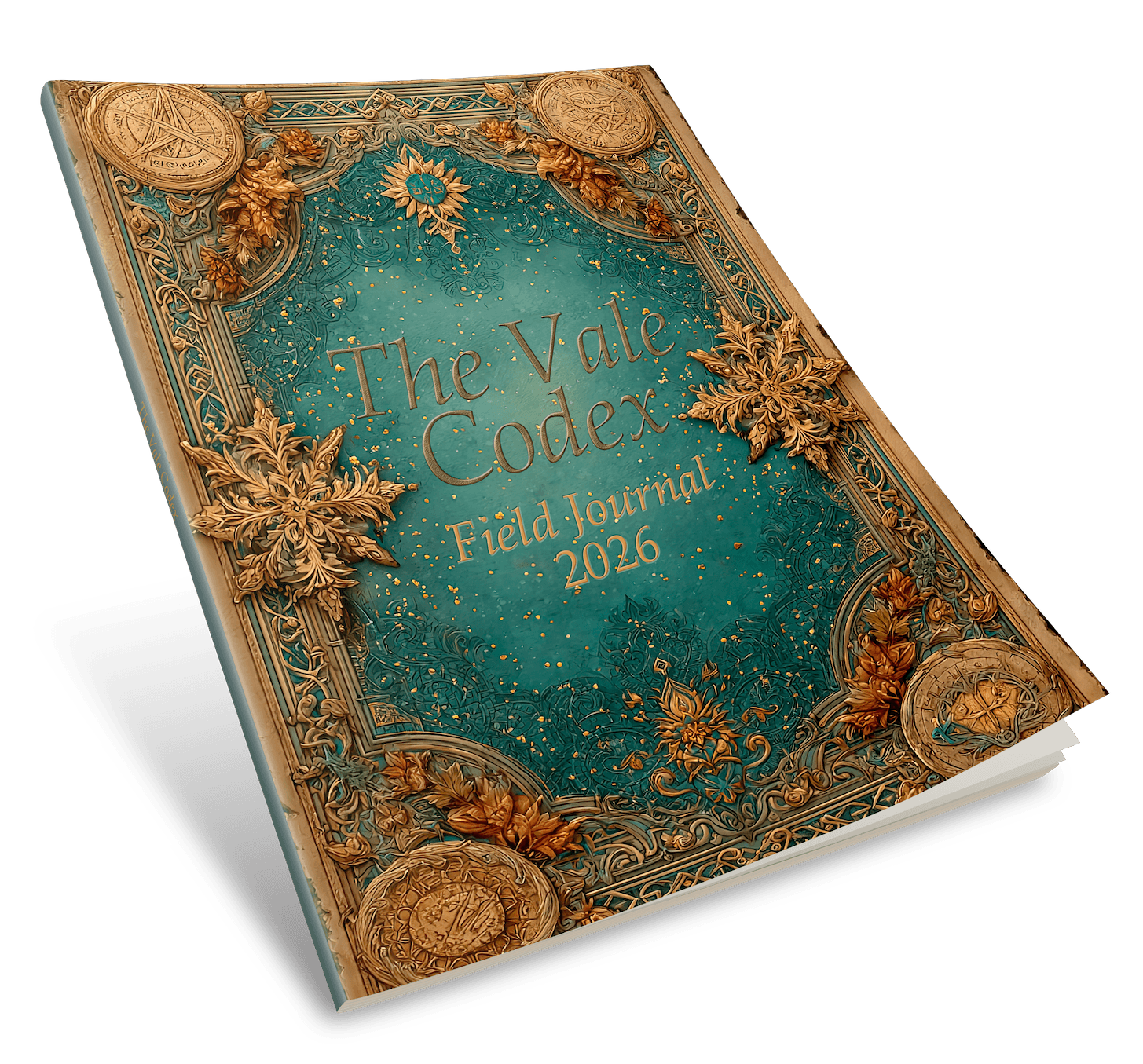
"GREAT NEWS... The 2026 Vale Codex Field Journal is available to download NOW!
The 48-page journal is a friend to carry on your own journey, expanding your mind and illuminating your path.
Tap this link to find out how to get your complimentary PDF copy right now!"
Kind regards, Rowan.