ROWAN VALE
The Four Elements
The Four Elements: A Living Map of the World.
Long before they were diagrams in occult manuals or keywords in modern spirituality, the four elements were ways of paying attention. They were how people read the land, weathered the seasons, understood temperament, illness, growth, and decay. Earth, Air, Fire, and Water were not abstractions but living forces encountered daily in field and hearth, breath and blood, rain and ash.
Across cultures and centuries, these elements became a shared language for describing both the outer world and inner life. They offered a framework that was practical, poetic, and deeply ecological. To speak of the elements was to speak of relationship: between soil and seed, wind and voice, flame and will, tide and memory.
This is not a system that belongs to one tradition. Versions of elemental thinking appear in ancient Greece and Egypt, in early Indian philosophy, in Chinese cosmology (though structured differently), in Celtic lore, medieval medicine, alchemy, and folk magic. The names shift, the correspondences vary, but the impulse remains the same—to understand life as a balance of forces in motion.
What follows is not a list of rigid meanings, but a portrait of the four elements as they still move through landscape, body, story, and ritual.
Earth: Bone, Field, Foundation
Earth is the element of form. It is soil compacted by time, stone shaped by pressure, the slow architecture of mountains and valleys. In human terms, Earth governs the body, the bones, the structures that hold life in place. It is associated with stability, endurance, patience, and memory.
Mythically, Earth is often personified as a mother, but this is not a sentimental figure. She is as capable of burial as she is of birth. Earth receives everything: fallen leaves, broken tools, the dead. In doing so, she transforms waste into fertility. Compost is Earth’s quiet alchemy.
In elemental systems, Earth is linked to the north, to winter, to midnight. It teaches the virtue of stillness. Not stagnation, but rest—the necessary pause in which roots deepen and strength accumulates. This is the element that asks: what are you building, and will it last?
In personal practice, Earth appears when we tend a garden, clean a home, organise our work, care for the body. It is present in craft, in long-term projects, in the discipline of showing up again and again. When Earth is neglected, life becomes ungrounded—ideas multiply but nothing takes shape. When it is overemphasised, rigidity can set in.
To work with Earth is to learn the value of limits. A field can only hold so much seed. A life can only sustain so many commitments. Earth teaches discernment through weight and consequence.
Air: Breath, Thought, Story
Air is the most elusive of the elements. Invisible, ever-moving, it is known through its effects: wind in the trees, breath in the lungs, words leaving the mouth. Air governs thought, communication, curiosity, and connection.
In myth, Air is often associated with birds, messengers, tricksters, and gods of language and knowledge. It is the realm of ideas and inspiration, but also of confusion and illusion. A sudden gust can clear the sky—or scatter everything in its path.
Elementally, Air aligns with the east, with dawn, with spring. It is the moment of beginning, when the world inhales. This is the element of questions, of learning, of possibility. It asks: what are you noticing? What are you saying, and why?
Air lives in conversation, reading, writing, teaching, travel. It thrives in open windows and long walks, in laughter and debate. When Air is blocked, thinking becomes heavy, repetitive, closed. When it dominates, life can become unmoored—full of plans, short on presence.
To work with Air is to cultivate clarity. This does not mean certainty, but movement. Air teaches that thoughts are weather patterns, not truths carved in stone. They pass. They change. You can choose which ones to follow.
Fire: Spark, Will, Transformation
Fire is the most dramatic of the elements. It gives light and heat, cooks food, forges metal—but it also destroys indiscriminately. Fire is power in its most visible form. It governs will, passion, creativity, courage, and change.
In myth, Fire is stolen from the gods, guarded by dragons, hidden in the hearth. It is sacred and dangerous, a gift that must be tended. Too little Fire and life grows cold, inert. Too much and everything burns.
Elementally, Fire is linked to the south, to noon, to summer. It is the height of energy, the blaze of action. Fire asks: what do you want badly enough to risk transformation?
In personal terms, Fire is motivation, desire, anger, enthusiasm. It is present when we begin something new, when we speak a difficult truth, when we commit fully to a path. Fire burns through hesitation and fear—but it must be fed wisely.
When Fire is suppressed, it often leaks out sideways as resentment or exhaustion. When it runs unchecked, it can consume relationships, health, and purpose. Fire needs boundaries. A hearth contains flame so it can serve life rather than destroy it.
To work with Fire is to learn responsibility for one’s power. Every spark has consequences. Every act of creation leaves ash behind.
Water: Blood, Tide, Memory
Water is the element of flow. It shapes landscapes over time, yields and persists, erodes stone grain by grain. In the body, it governs blood, lymph, and the vast inner sea of emotion and intuition.
Mythically, Water is associated with the deep: wells, rivers, oceans, and the beings that inhabit them. It is the realm of ancestors, dreams, and the unconscious. Water remembers. It carries stories downstream.
Elementally, Water aligns with the west, with dusk, with autumn. It is the season of letting go, of harvest and grief, of reflection. Water asks: what are you feeling, and what are you holding?
Water lives in tears, in tides of longing, in the quiet pull of nostalgia. It is present in ritual baths, in rain against the window, in the ache of beauty. When Water is blocked, feeling stagnates and turns sour. When it overwhelms, boundaries dissolve.
To work with Water is to practice listening—especially to what has no words. It teaches that emotion is not weakness but information. Like rivers, feelings must move to remain alive.
Balance and the Fifth Presence
While the four elements are often described individually, they were never meant to exist in isolation. Life arises through their interplay: Earth gives form, Water gives movement, Fire gives energy, Air gives direction. A seed needs all four to become a tree.
Many traditions speak of a fifth element—the spirit, aether, or quintessence—that arises when the others are in balance. This is not something separate, but the pattern they create together. It is presence, coherence, the sense of being fully alive and aligned.
Elemental imbalance is not a moral failing; it is a natural state that shifts with season and circumstance. The work is not perfection but awareness. Which element is calling for attention right now? Which is in excess, which in retreat?
To live elementally is to live in conversation with the world. To notice weather and mood, hunger and inspiration, rest and action. It is a way of reading both landscape and self as sacred text.
The four elements are not relics of a pre-scientific past. They are enduring metaphors rooted in observation and experience. They remind us that we are not separate from the forces we name—we are made of them.
Earth in our bones. Air in our breath. Fire in our will. Water in our blood. The old map still works, if we know how to read it.
Kind regards, Rowan.
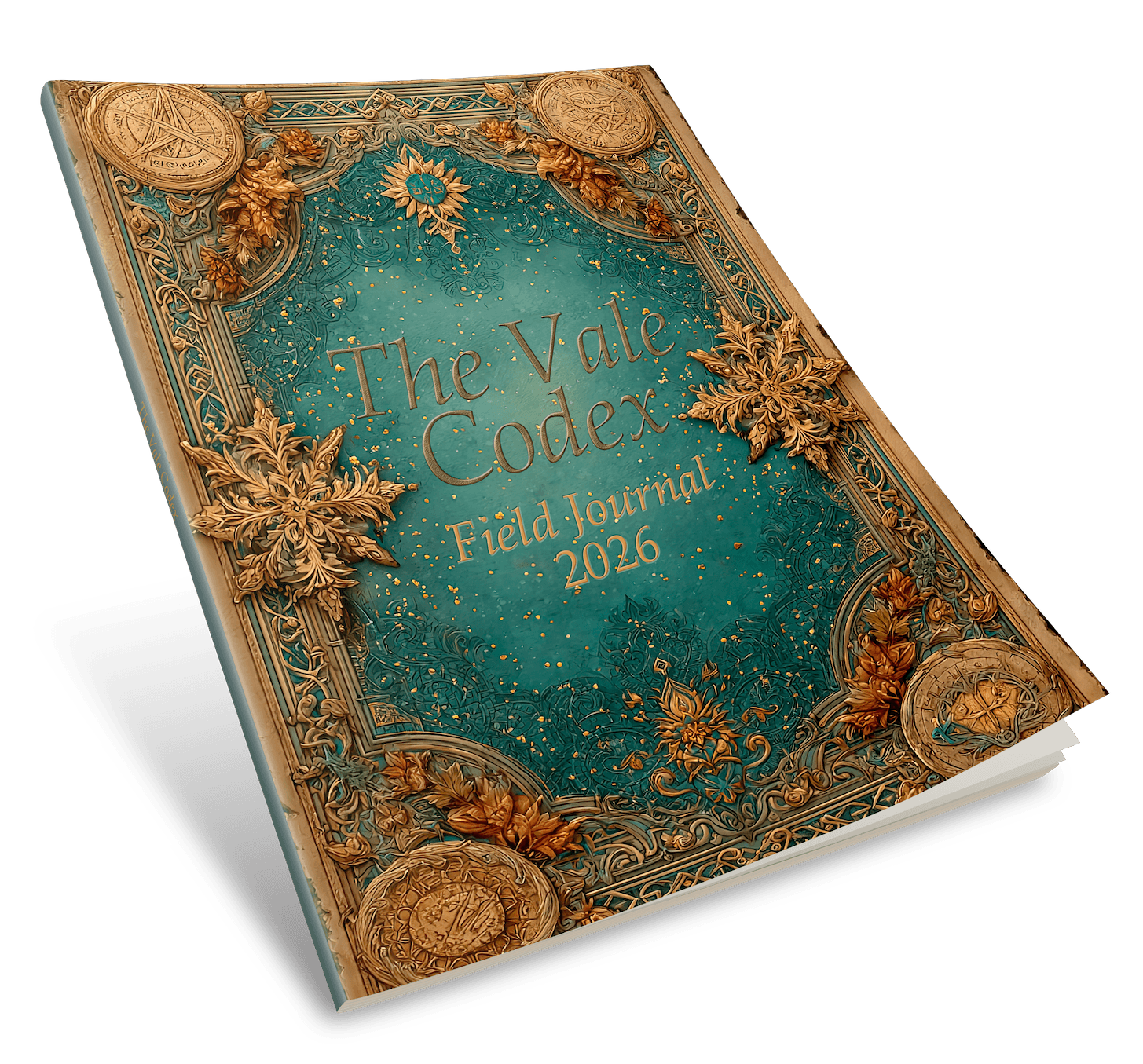
"GREAT NEWS... The 2026 Vale Codex Field Journal is available to download NOW!
The 48-page journal is a friend to carry on your own journey, expanding your mind and illuminating your path.
Tap this link to find out how to get your complimentary PDF copy right now!"
Kind regards, Rowan.