ROWAN VALE
Lessons from the Dark Half
Understanding Your Shadow Self
There’s something about the darker half of the year that draws me inward. As the days shorten and the landscape settles into autumn mists, I find myself thinking less about what lies ahead and more about what lies beneath the surface. The bare branches, the fading light and the quiet of the woods seem to invite a different kind of attention, one that turns away from the noise of everyday life and towards the quieter workings of the inner world.
Perhaps this is why I've always been drawn to the old stories of descent and return, to the ancient myths that speak of journeys into darkness and the wisdom that might be found there. They remind me that not every season of life is about growth, achievement or moving forward. Sometimes, there's value in stepping back, looking inward and allowing ourselves to sit with the questions we can't yet answer.
At Rowan Vale, I explore the connections between the natural world, ancient mythology and our own experiences of being human. The changing seasons offer a constant reminder that life moves through cycles of light and shadow, beginnings and endings, renewal and retreat. Yet these cycles aren't confined to the landscape around us. They're reflected in our own lives, too.
The dark half, then, is more than a season on the calendar. It is also a way of understanding those periods when familiar certainties fall away and we're invited to look more honestly at ourselves. It's here, in the quieter places, that some of our most important lessons begin.
The Darkness Reveals What the Light Conceals

You build your identity around the roles you play and the expectations you inherit. You become the dependable one, the strong one, the person who always finds a way forward. Over time, these identities can become so familiar that you forget to question whether they truly reflect who you are.
Then life intervenes. A relationship ends, an ambition falls away, or circumstances force you to reconsider the direction you've taken.
Such experiences can be painful, but they may also reveal truths that everyday life keeps hidden. You might recognise how much of your happiness depends upon the approval of others, or how often you sacrifice your own needs to maintain an appearance of being in control.
The darkness strips away some of the distractions. It asks you to examine the foundations upon which you've built your life.
This isn't always comfortable. Honest reflection can expose regrets and disappointments, but it can also uncover forgotten ambitions and possibilities you once dismissed.
Sometimes, you must lose your familiar sense of direction before you understand where you truly want to go.
Making Peace with Your Shadow Self
The psychologist Carl Jung developed the concept of the shadow to describe aspects of yourself that remain outside your conscious understanding or that you prefer to hide.
Your shadow may contain anger, jealousy, insecurity or resentment. It can also hold qualities you've suppressed because they conflict with the image you present to the world. Creativity, independence and ambition can all become hidden when you fear rejection or disapproval.
The problem isn't that these qualities exist, but that you refuse to acknowledge them.
Perhaps you pride yourself on always being agreeable, yet discover that unexpressed frustration has become resentment. Maybe you've avoided pursuing a creative ambition because you fear being judged.
Shadow work begins when you become curious about these contradictions rather than condemning yourself for having them.
Ask yourself which emotions you struggle to express, what repeatedly provokes your anger, or why certain qualities in others produce such strong reactions.
Understanding your shadow doesn't mean excusing harmful behaviour. It means becoming more conscious of your motivations so that you can make better choices.
You can't change what you refuse to acknowledge. Sometimes, becoming whole begins with accepting that the parts of yourself you hide deserve to be understood.
The Lessons Hidden in Difficult Seasons
When life becomes painful, you naturally search for meaning. You want to understand why something happened and whether the experience might lead to something better.
Sometimes, hardship reveals where change is needed. It may expose an unhealthy relationship, an unsustainable way of living or a belief that no longer serves you.
But not every painful experience arrives with a lesson attached. Some losses are simply losses, and some suffering has no satisfying explanation. You shouldn't feel obliged to discover a hidden purpose before allowing yourself to grieve.
Growth doesn't require you to be grateful for everything that hurts you.
Instead, you can recognise that even when you can't change what's happened, you may eventually discover new ways of living with it. A difficult season might deepen your compassion, clarify your priorities or help you understand what you need from life.
Sometimes, the greatest lesson is discovering that you can endure uncertainty without having all the answers. You can acknowledge your pain, seek support and allow yourself time to recover.
Fear and the Threshold of Change
Fear protects you from danger, but it can also keep you trapped in situations that have become restrictive or unfulfilling.
You remain silent because you fear rejection. You avoid change because you can't predict the outcome. You cling to familiar circumstances because the unknown seems more frightening than the unhappiness you already understand.
Fear can become a gatekeeper, standing between you and possibilities you might otherwise explore.
The challenge is to recognise the difference between a genuine warning and the discomfort that accompanies change. Not every risk is worth taking, but neither should you assume that uncertainty is always a reason to turn back.
Courage doesn’t mean living without fear. It means examining your fears rather than allowing them to make every decision for you.
When you enter the dark half, you may discover that the things you fear losing are not always the things you need most.
The important question is not simply what you fear, but what that fear prevents you from becoming.
The Wisdom of Solitude and Nature
There’s a particular clarity that can emerge when you step away from the noise of everyday life.
A walk through woodland, rain falling through bare branches, or the stillness of a mist-covered river can offer a welcome pause from the constant demands of modern living. In these moments, you may begin listening more closely to thoughts and feelings easily drowned out by distraction.
Nature reminds you that not all growth is immediately visible.
During autumn, trees release their leaves. Through winter, the landscape becomes subdued, yet beneath the soil, the processes of life continue. What appears to be an ending is often part of a larger cycle.
Your life contains similar periods. You may need time to grieve, recover, reconsider your priorities or simply rest. These quieter seasons aren't necessarily signs of failure.
Solitude can provide valuable space for reflection, although it shouldn't become a substitute for human connection when you need support.
Sometimes, you need to stop striving long enough to discover what truly matters.
Ancient Myths of Descent and Return
The journey into darkness is a recurring theme in ancient mythology. Stories of underworld journeys explore loss, vulnerability, transformation and the possibility of return.
In Greek mythology, Persephone's descent into the underworld becomes part of the explanation for the changing seasons, connecting absence and return, barrenness and renewal.
In the Mesopotamian myth of Inanna, the goddess descends into the underworld, passing through seven gates and surrendering symbols of her power before confronting the realm of the dead.
These myths offer no simple promise that every difficult experience will end happily. Their enduring power lies in their recognition that descent can be part of a larger journey.
You may lose an old identity before discovering a new one. You may have to confront uncomfortable truths before moving forward. You may emerge from a difficult period changed, carrying a different understanding of yourself and the world.
Yet the return matters as much as the descent. The purpose of reflection is not to remain absorbed in your wounds, but to use what you’ve discovered to live with greater awareness.

Finding Wholeness in Your Shadows
Perhaps the deepest lesson from the dark half is that wholeness doesn’t mean perfection.
You’re a complicated creature, capable of generosity and selfishness, courage and fear, certainty and doubt. Personal growth doesn’t require you to eliminate every contradiction. It asks you to understand yourself more honestly and take responsibility for your choices.
Self-acceptance isn’t an excuse to remain unchanged. It’s the foundation from which meaningful change is possible.
You can acknowledge your weaknesses without allowing them to define you. You can recognise your mistakes without believing they make you beyond redemption. You can accept difficult emotions without allowing them to determine how you treat others.
Like the natural world, you are shaped by cycles of growth, decline, rest and renewal. The darkness has its place, but it doesn’t tell your whole story.
You don’t need to conquer every shadow or find an explanation for every hardship. You only need to remain willing to look honestly at what lies before you and take the next step when your’e ready.
The light doesn’t need to destroy the darkness. It simply allows you to see the landscape more clearly, including paths you couldn’t see before.
A Rowan Reflection
What’s your own dark half taught you? Perhaps it’s revealed a truth you’d long avoided, helped you recognise an old pattern, or shown you the importance of slowing down and listening to yourself.
Take a little time to reflect upon the seasons you’ve passed through. You don’t need to find meaning in every difficulty or rush towards a new beginning.
Sometimes, it’s enough to recognise where you are, accept what you feel and trust that the landscape will change again in its own time.
Somehow the Universe always seems to sort things out.
Kind regards,
Rowan.
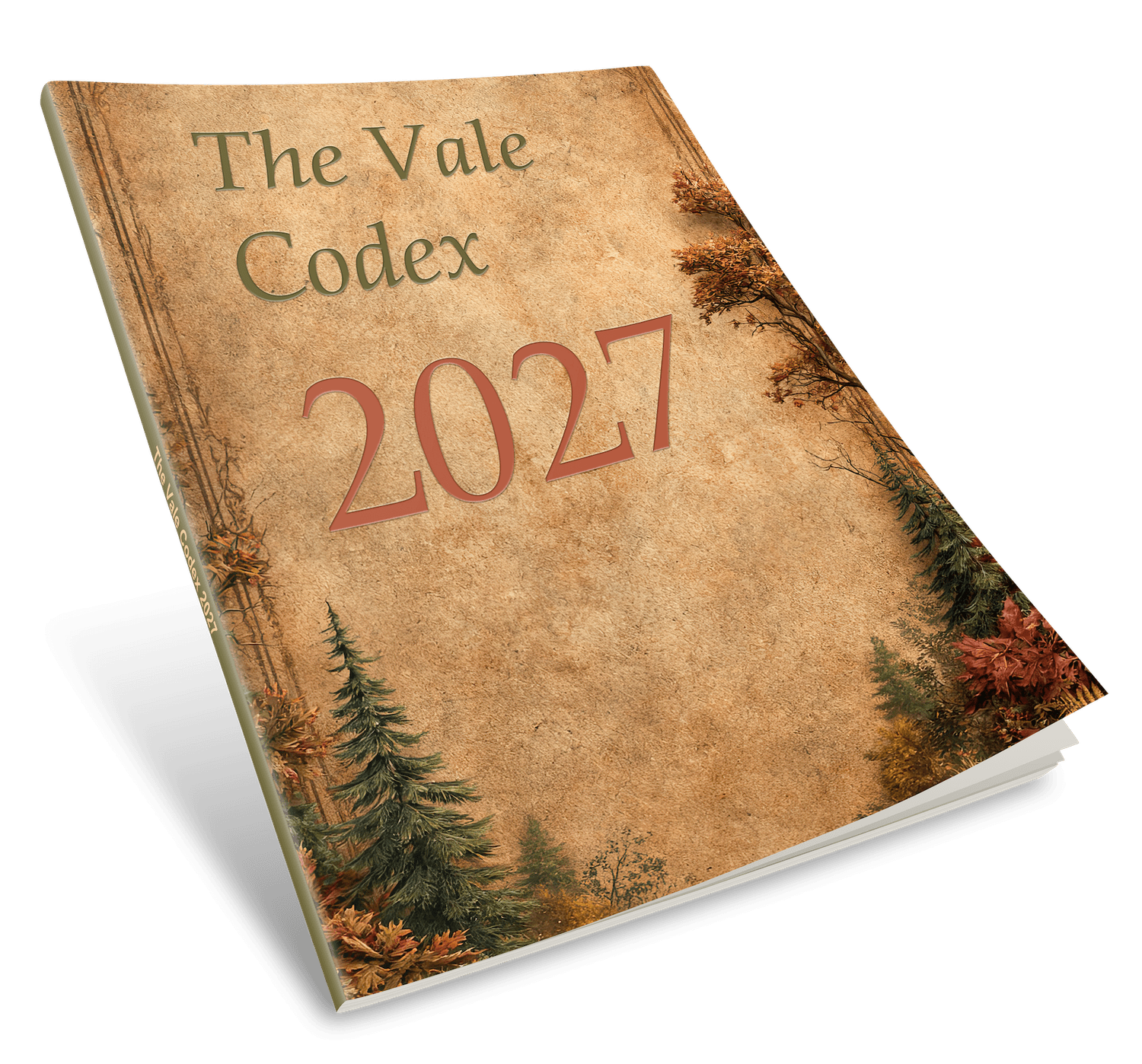
"GREAT NEWS... The 2027 Vale Codex Field Journal is available to download NOW!
The 48-page journal is a friend to carry on your own journey, expanding your mind and illuminating your path.
Tap this link to find out how to get your complimentary PDF copy right now!"
Kind regards, Rowan.