ROWAN VALE
Imbolc and Brigid: The Awakening of Spring
As we say goodbye to a cold January the cross‑quarter Sabbat of Imbolc is here, marking the first stirrings of spring. Imbolc arrives quietly. There is no dramatic burst of blossom or sudden warmth, no clear signal that winter has begun to release its grip. Instead, this ancient festival—celebrated around February 1st—marks something subtler and, in many ways, more profound: the first stirring of life beneath the frozen soil.
The lambing season begins, daylight lengthens almost imperceptibly, and the land exhales after holding its breath. Imbolc is not about spring in full voice; it is about the promise of spring, sensed more than seen. And tonight we have a full moon to light the way.
At the heart of Imbolc stands Brigid, one of the most enduring and beloved figures of the Celtic world. Goddess, saint, poet, healer, smith, guardian of hearth and home—Brigid resists simple definition. Her presence at Imbolc weaves together themes of renewal, creativity, and continuity, binding the agricultural rhythms of the land to the inner lives of those who tend it.
The Meaning of Imbolc
The name Imbolc is generally understood to derive from Old Irish terms connected with milk and lactation, a reference to ewes coming into milk as lambs are born. This agricultural marker anchors the festival firmly in lived, seasonal reality. Food security, survival, and hope for the coming year all hinge on these early signs that the land is once again becoming generous.
In the traditional Celtic calendar, Imbolc sits midway between the winter solstice and the spring equinox. It is a hinge point in the year—a threshold rather than a destination. Winter is still very much present, but its dominance is no longer absolute. The earth is awakening internally, even if its surface remains cold and grey.
Historically, Imbolc was a time for purification and preparation. Homes were cleaned, tools repaired, and intentions quietly set. It was a festival less about feasting and more about readiness: tending the hearth, conserving energy, and honouring the fragile beginnings that would later bloom into abundance.
Brigid: A Goddess of Many Fires
Imbolc is inseparable from Brigid. While many Celtic deities were tied to specific regions or tribes, Brigid’s veneration spread widely across Irish-Celtic territories, a testament to her exceptional importance. Her influence crossed boundaries of class, profession, and landscape, touching nearly every aspect of daily life.
Brigid is a goddess of learning and poetry, of healing and fertility, of smithcraft and sacred fire. At first glance, these domains may seem disparate, but they are united by a deeper logic. All involve transformation. Poetry shapes language into meaning. Healing turns illness into wholeness. Smithcraft transforms raw metal into tools of survival. Fire, at the centre of all these acts, is both destructive and creative—capable of ruin, yet essential for life.
In this way, Brigid embodies a holistic understanding of creativity: not as something abstract or decorative, but as a force that sustains communities. Inspiration and practicality are not opposites under her guardianship; they are partners.
The Sacred Hearth
One of Brigid’s most enduring symbols is the hearth fire. In the ancient world, the hearth was the physical and spiritual centre of the home. It provided warmth, light, cooked food, and offered protection against the dark. To tend the hearth was to tend life itself.
Brigid’s association with fire is not the wild blaze of summer or battle, but the steady, life-giving flame that endures through winter. This makes her a natural patron of Imbolc. As the days begin to lengthen, her fire is rekindled—both literally and symbolically. In some traditions, hearth fires were extinguished and relit in her honour, marking a renewal of domestic and spiritual energy.
The hearth also represents continuity. Even when fields lie fallow and travel is dangerous, the fire burns on. Under Brigid’s watch, it becomes a symbol of hope and perseverance, reminding communities that endurance itself is a sacred act.
Poetry, Prophecy, and the Spoken Word
Brigid’s role as a goddess of poetry and prophecy places her within the intellectual and spiritual heart of Celtic society. Poets were not merely entertainers; they were historians, satirists, seers, and keepers of cultural memory. Their words carried power—the ability to bless, curse, inspire, or shame.
At Imbolc, when the world feels suspended between what has been and what will be, this emphasis on language and vision feels particularly apt. The future is not yet visible, but it can be imagined, spoken into being through intention and story. Brigid presides over this liminal space, where possibility begins to take shape.
In later folklore, Brigid is said to walk the land on the eve of Imbolc, blessing homes and fields. People left cloth or ribbons outside to receive her healing touch—a tradition that echoes her association with both physical and spiritual restoration.
Healing and Renewal
Healing is another central aspect of Brigid’s identity. Wells and springs dedicated to her became places of pilgrimage, where water was believed to carry her restorative power. These sacred waters were often visited at Imbolc, reinforcing the festival’s themes of cleansing and renewal.
This is not dramatic, instantaneous healing, but gradual mending—the kind that mirrors the season itself. Just as the land does not burst into life overnight, the healing Brigid offers unfolds slowly, requiring patience and trust. Imbolc invites reflection on what has been depleted over winter, whether in body, mind, or spirit, and what needs gentle care to return to strength.
From Goddess to Saint
Brigid’s influence did not fade with the arrival of Christianity. Instead, she transformed. Saint Brigid of Kildare inherited many of the goddess’s attributes, including her association with fire, healing, and hospitality. The perpetual flame tended by her nuns at Kildare echoes the ancient hearth fire, suggesting continuity rather than erasure.
This blending of goddess and saint highlights Brigid’s deep-rooted presence in the cultural imagination. She is not confined to a single belief system but moves fluidly through them, adapting while retaining her core essence. For many, this makes her a powerful symbol of resilience and adaptability—qualities deeply aligned with Imbolc itself.
Imbolc Today
In contemporary practice, Imbolc is often marked with candle lighting, poetry, quiet rituals, and acts of preparation rather than celebration. It is a time to take stock, to notice small signs of change, and to honour beginnings that are not yet ready to be seen.
Brigid’s relevance endures because she speaks to both creativity and responsibility. She reminds us that inspiration must be tended like a fire, that healing requires attention, and that craftsmanship—whether artistic or practical—is a sacred act when done with care.
Imbolc does not ask for grand gestures. It asks for attentiveness. For listening to the land, to the body, to the quiet voice that says: something is stirring.
As winter loosens its hold, Brigid stands at the threshold, torch in hand. Not to banish the cold outright, but to illuminate the path forward—step by careful step—into the returning light.
Warmly, Rowan.
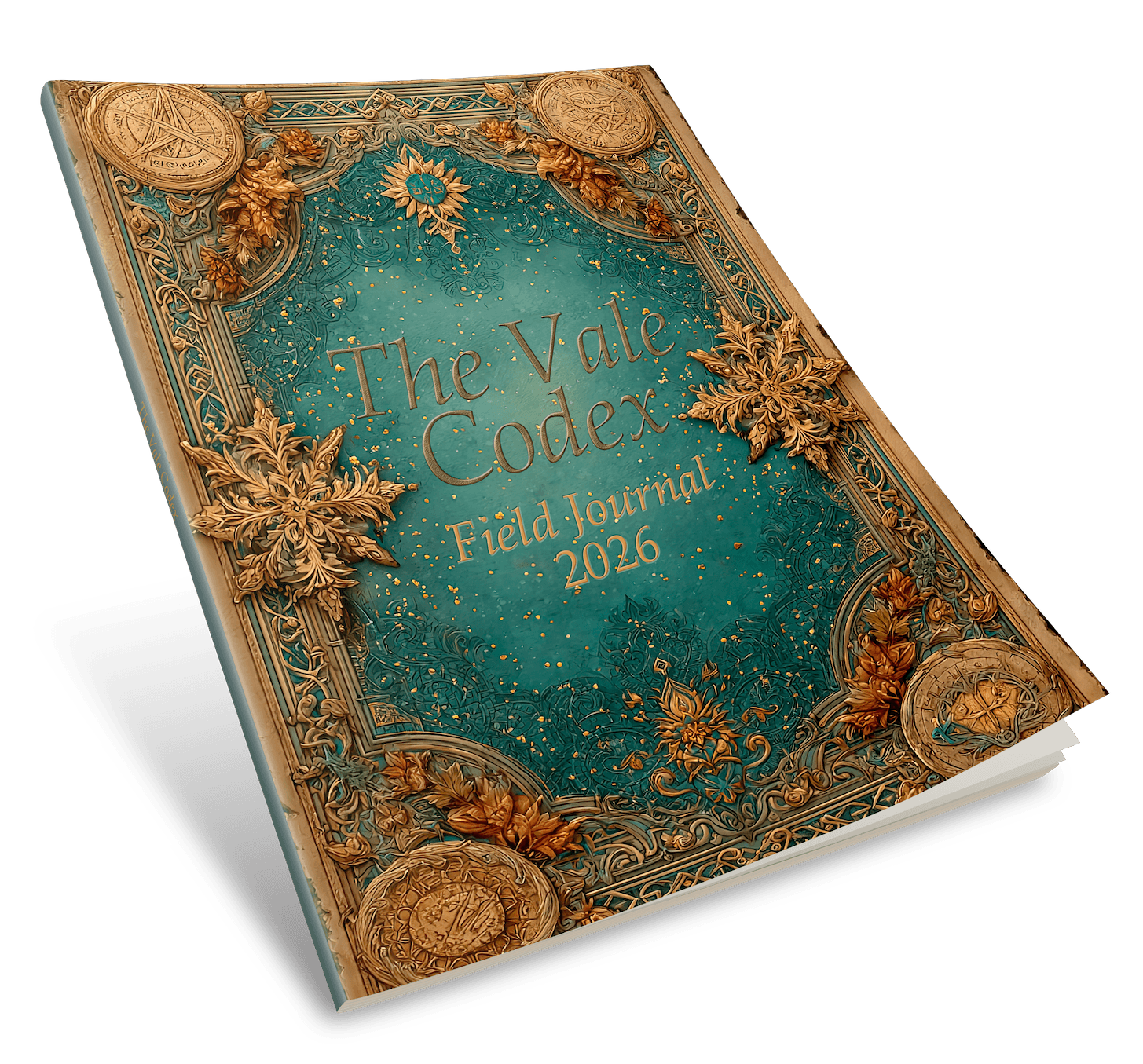
"GREAT NEWS... The 2026 Vale Codex Field Journal is available to download NOW!
The 48-page journal is a friend to carry on your own journey, expanding your mind and illuminating your path.
Tap this link to find out how to get your complimentary PDF copy right now!"
Kind regards, Rowan.