
ROWAN VALE
Birch at the Threshold
Birch at the Threshold: January, Renewal, and the Dark Moon Promise.
January is a quiet month, but it is not an empty one. Beneath frost and sodden leaf litter, life is already shifting, gathering itself. The land is not asleep so much as listening. This is the month of thresholds: the old year has loosened its grip, yet the new one has not fully arrived. In the old tree calendars of northern Europe, January belongs to the Birch — a tree of beginnings, of first light, of white bark gleaming against winter shadow.
As the new moon approaches on the 18th (three days from today), Birch steps forward as both symbol and companion. This is not the exuberant renewal of spring, but a subtler, more disciplined rebirth: one that happens in darkness, in silence, before any visible sign appears.
The First Tree
Birch has long been understood as the first tree — the pioneer species that colonises cleared land after fire, storm, or human disturbance. It was the first tree to arrive in Britain after the last ice age. It is the tree that arrives when everything else has fallen away. In ecological terms, Birch prepares the soil for others, enriching and stabilising it so slower-growing trees can follow. In mythic terms, this makes Birch the guardian of beginnings, the one who stands at the edge between what has ended and what may yet come.
In the ogham tradition, Birch is Beith, the first letter of the tree alphabet. Its position is not accidental. Beith speaks of initiation, purification, and the fragile courage required to begin again. January, too, is a first letter of sorts — not because it is full of energy, but because it offers a clean margin. The page is blank, but the ink has not yet warmed in the pen.
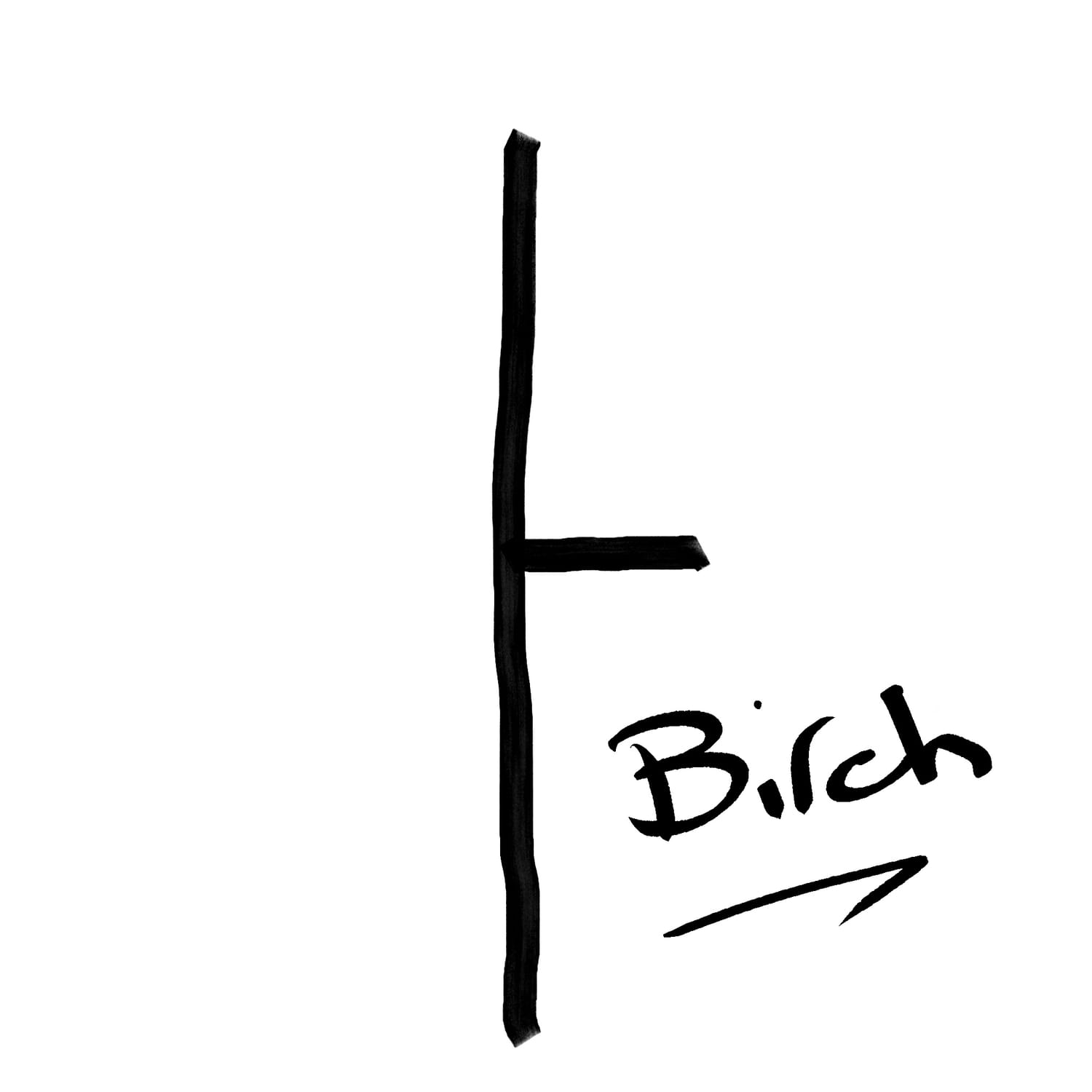
The Ogham symbol for Birch
Birch does not ask for grand resolutions. It asks for honesty.
White Bark, Dark Season
What makes Birch especially striking in January is its appearance. While most trees withdraw into the anonymity of winter, Birch shines. Its pale bark reflects what little light there is, standing out against iron skies and frozen ground. In folklore, this whiteness is associated with purification and protection. Birch branches were used in ritual sweeping as a way of clearing stagnant energy, both physical and spiritual.
This matters now, in the deepest stretch of winter. January is a month when the psyche can feel heavy. The festivities have passed; the days are still short; the weather presses inward. Birch does not banish this darkness — instead, it teaches how to move within it without being consumed.
The tree’s message is simple and demanding: clear what no longer serves, but do not rush what has not yet formed.
Birch and the Body of the Land
Birch is a tree of sap. Even in late winter, before leaves appear, the sap begins to rise. Traditionally, birch sap was tapped as a spring tonic — cleansing the blood, supporting the kidneys, restoring vitality after months of preserved food and low light. That upward movement begins invisibly, long before anyone would call it spring.
January holds this same quiet stirring. We may not feel renewed, but something has shifted. The land knows it. Birch knows it. The new moon on the 18th arrives not as a blaze of intention, but as a sealed vessel — a dark bowl waiting to be filled. If other trees teach patience, Birch teaches timing.
The New Moon as Womb
A January new moon is not a moment for outward action. It is closer to a womb than a doorway. The moon disappears entirely, returning us to darkness not as absence, but as potential. When paired with Birch, this lunar phase becomes especially potent.
Birch is associated with feminine resilience — not softness, but endurance. It bends easily in wind, rarely breaking. It thrives in poor soil. It grows where it is not invited. During a new moon governed by Birch energy, the invitation is inward: to examine where resilience is needed, and where flexibility might serve better than force.
This is an ideal moment to set intentions that are skeletal rather than elaborate. Think framework, not finish. Structure, not spectacle. Birch does not bloom early, but when it does, it is unmistakable.
Memory, Ancestry, and the Birch Cradle
In many northern traditions, Birch is linked to birth and ancestry. Cradles were carved from birchwood; its bark was used for writing, preserving memory long before paper. Birch holds stories lightly but securely, offering continuity through cycles of loss and renewal.
January often brings reflection on lineage — personal or cultural. The new moon may stir questions about where you come from, what patterns you are repeating, and which ones are ready to end. Birch does not judge these patterns. It simply offers a clean surface on which something truer can be written.
This is a good moon for ancestral listening rather than ancestral storytelling. Let the past speak before deciding what to carry forward.
Fire, Ice, and the Birch Paradox
Birch is paradoxical. Its bark burns even when wet, making it invaluable for fire-lighting in winter — yet it is also a tree of ice, thriving in cold climates and thin soils. This union of fire and frost is deeply January in nature. The month holds both the exhaustion of winter and the first spark of return.
The new moon amplifies this tension. It is a point of compression: everything drawn inward, heat contained beneath cold surfaces. Under Birch influence, this compression becomes purposeful rather than suffocating.
If there is anger, grief, or fatigue present now, Birch does not demand release. It asks for containment — not suppression, but careful holding. Fire, after all, needs structure to burn without destroying.
Working with Birch Energy This January
You don’t need elaborate ritual to honour Birch and the new moon. Simple acts carry the deepest resonance this time of year.
Walk among birch trees if you can. Notice their posture, their spacing, their light-catching bark.
Clear one small physical space — a drawer, a shelf, a corner — with intention rather than haste.
Write a single sentence on the new moon. Not a plan, but a truth. Let it be unfinished.
Drink water mindfully, remembering sap rising beneath frozen ground.
Birch teaches that beginnings are rarely dramatic. They are often quiet, slightly uncomfortable, and easily overlooked.
The Promise Beneath the Snow
January’s Birch is not the tree of celebration, but of permission. Permission to start again without certainty. Permission to rest without guilt. Permission to believe that something is happening, even when there is no evidence yet.
As the new moon on the 18th passes unseen across the sky, Birch stands luminous in the darkness, reminding us that renewal does not require light to begin. It requires honesty, patience, and a willingness to stand exposed — pale against the winter — trusting that sap knows when to rise.
What you begin now will not ask to be rushed. Like Birch, it will ask only to be allowed.
Regards, Rowan.
"GREAT NEWS... The 2026 Vale Codex Field Journal is available to download NOW!
The 48-page journal is a friend to carry on your own journey, expanding your mind and illuminating your path.
Tap this link to find out how to get your complimentary PDF copy right now!"
Kind regards, Rowan.